Episode Transcript
[00:00:00] Speaker A: If you look at what the Buddha said, he says on this very, very long path of profound awakening, he says the most important thing is noble friendship. And so you're like, well, how do we actually get to that? We let alone we don't even have regular friendships these days. So how will we get to, you know, these deep, noble friendships? There was a Wall Street Journal article recently that said Zuckerberg's trillion dollar vision, everyone should have more AI companions.
He's providing the market solution, which is to say, look, you don't have enough connection in the world, so I'm going to bring in AI companions to give you that sense of inner resiliency. But another solution is inner transformation is coming together with each other because of that inner transformation, that if our hearts come together, there's a whole that is greater than the sum of the parts. I think of it as like, you know, Mark Zuckerberg's metaverse, which is meta, and this being metaverse Metta, which is really the heart verse, right, which is loving kindness in Pali.
But like, can we actually take this track? And I think we have to as humanity.
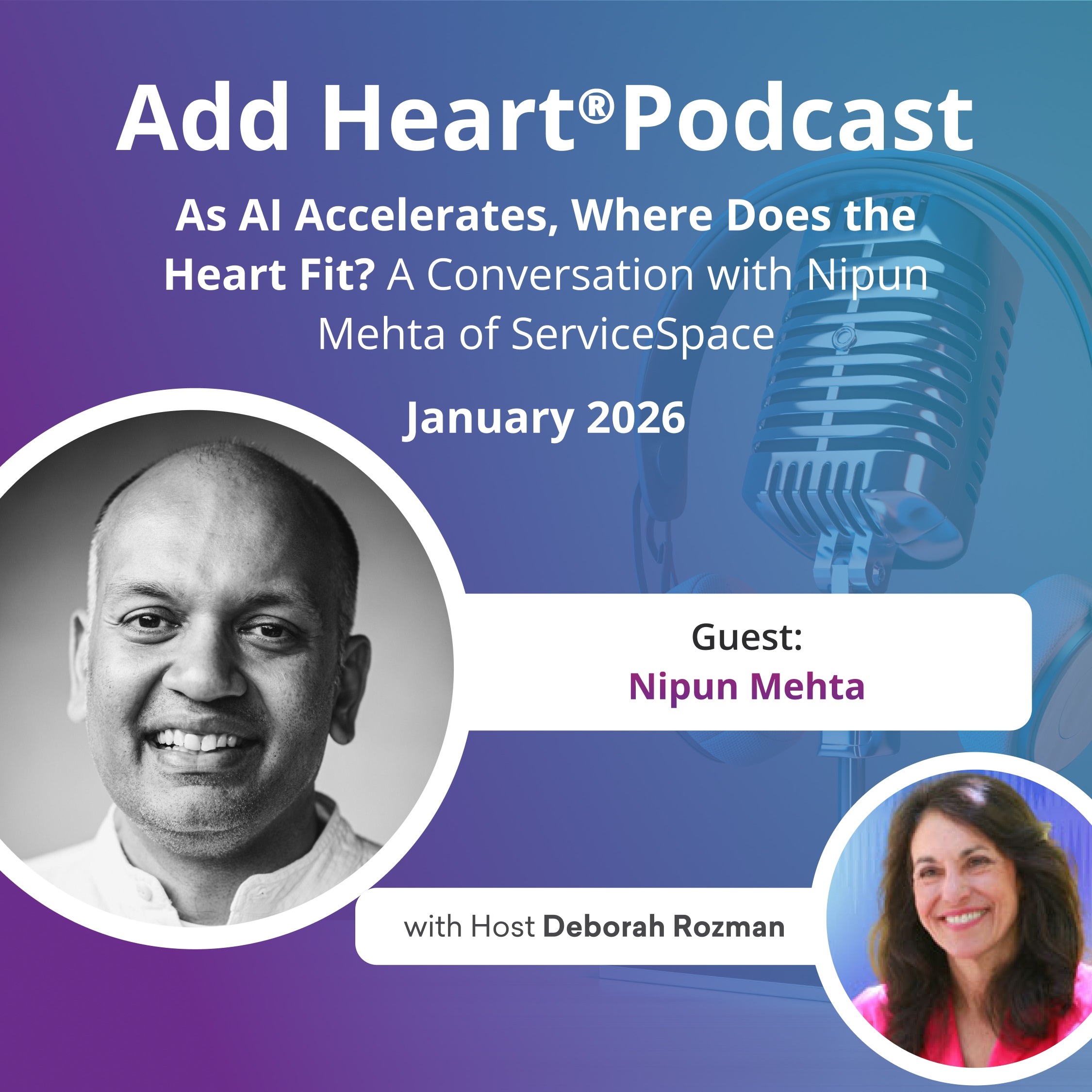
[00:01:19] Speaker B: Hi, I'm Deborah Rossman and a warm welcome to our listeners.
Each month for the adheart podcast, I have the privilege of interviewing individuals who are contributing to the creation of a more heart based world.
And this month I'm talking with Nipun Mehta. Nipun is the founder of Service Space.org and it reaches millions every month.
It's a global community and for the last 25 years, service space has been an incubator of compassionate action, working at the intersection of technology, volunteerism and a gift culture with projects ranging from a platform that publishes good news, to a restaurant where everyone pays it forward for each other, to meditation circles without teachers and living rooms, to most recently, powering powerful applications of AI.
So we're going to be talking about that because I'm fascinated by what's happening with AI and what Nippon's vision and interest in the whole AI plus heart movement is.
But one of the things I have to add in this introduction is that his entire efforts are nature funded.
No fundraising, advertising or solicitation, driven totally by gratitude.
And it has expanded to millions because of that. Nippon was honored as an unsung hero of compassion by the Dalai Lama, and former U.S. president Obama appointed him to a council for addressing poverty and inequality in the U.S. so, fascinating person. I'm so glad you're with us. Welcome, Nipun.
[00:03:10] Speaker A: Thank you for having me, Deborah. It's such a joy to Be here amongst all of you.
[00:03:16] Speaker B: Well, you know, we're all living in extremely turbulent times and I think there's a lot of fear, a lot of uncertainty. There's fear that AI is going to change everything and it's changing things so fast.
What's the possibility for a real heart centered future? Because there's people waking up to the heart going, something has to change, we have to learn to get along or we don't have a future.
So what are your views on what's happening?
[00:03:46] Speaker A: Well, I mean, I think if I look at the world through my head's intelligence, it arrives at a very different conclusion than if I look at the world through my heart's intelligence. If I look at my head, there is this famous naturalist, E. O. Wilson, and he had this epic quote. He says the real problem of humanity is that we have Paleolithic emotions, medieval institutions and godlike technology.
And so I think this is kind of a recipe for disaster unless we upgrade our inner landscape and even how we organize and be with each other. So I think that's sort of the head thing is there's a lot of red flags that go up when you look at the accelerating status quo. But if I feel into my heart, it's like, how, how can we not make it? You know, as in if we are going to survive as a species, and sure there's chances that we might not, but if we are, it has to include this embodied intelligence.
So to me, by default, AI is going to automate and amplify the status quo. And the status quo isn't really something that works for everyone. It needs serious design upgrades.
But I think AI might invite us into different kinds of questions. So I often think of it as like the microscope and the telescope. They help us see things that we otherwise wouldn't be able to notice with our bare eyes. Can AI be and inner scope to help us become more embodied, to help us awaken this heart intelligence, to help us and to help us change in ways that we want to change.
So can it actually be that kind of a mirror for us personally? And then I think the second question I ask is not just an inner scope, but can it actually be an interscope that can bring us together as humans so that we can create a field of emergence, like start doing things together that we couldn't do alone. So it's not just an additive function, but a multiplier of what it truly means to be human. So can AI be this third force that helps us disentangle ourselves from these polarities? That we face. So, yeah, I think there's a way in which there is a future, at least when I feel with my heart where I see these things operating in a way that allows humans to thrive and flourish.
[00:06:36] Speaker B: You know, I couldn't agree with you more. And it's interesting.
The amplification of both perspectives is really, I believe, causing more people to say, okay, how do we use AI for good? In fact, there's a conference in that that I was just invited to, and I was invited to speak in just a couple months ago at a conference because they wanted a woman, a leader on AI and heart intelligence at MIT because they wanted to balance the other AI perspectives. I wasn't able to go there. I was in Greece at the time.
But what's interesting is how people are sensing that.
And so the exploration and question for you, how do you see wisdom, spirituality, heart intelligence, and AI all sitting at the same table?
[00:07:30] Speaker A: I mean, I think it's really important to get those voices in the room because I think all too often we have very singular kinds of intelligences that are guiding the arc of all of this. And so in so many ways, that dominant intelligence is the intellectual intelligence, but there are so many other forms of intelligences.
And so I think it's very important for us to be in that dialogue around it, because I think the status quo is just going to be to try to take these efficiencies of AI and deposit it into the most, you know, quickest way to get a market return from all of this. So I think we. We take.
We won't invest, you know, the gains from these AI efficiencies into the commons of humanity.
So how. How do we do that? And I think that's the big question. If we can answer that question, then I think they will sit at the same table.
But I think if we are just in a rush to just do the next thing and the quickest thing and the best way to get a monetizable market return from our products, then I think we will create lots and lots of unintended consequences. And frankly, this has been the history of technology. I mean, this is what technology has done. It's like, oh, social media sounds like a great idea to connect people across distances.
And then all of a sudden it's like, oh, actually it starts to erode the fabric of friendship and relationship. And so how do we, you know, and. And years later we come to grips with that and we say, oh, sorry, those were unintended consequences.
But why do. Why does tech have so many Unintended consequences, because wisdom and heart and compassion and kindness are at the table.
And so I think this is actually, we're at ground zero of AI right now. And I think it's very critical that we actually bring these different.
I don't want to just say voices. I would say actually different intelligences, and they all communicate in different ways.
So words is not just the only way to communicate, as, you know, more than anybody else. So, um, you know, how. How. How will we actually create this confluence of different intelligences that guides the arc of something so profoundly impactful like AI?
[00:10:07] Speaker B: These are important questions for sure. And what's hopeful for me? My heart's view is more people are waking up and asking that, or even, like you just said, social media. What a wonderful, original idea. Now we go. So social media has created a lot of the separation because the news feeds just feed people more of what they already read on social media. So that creates a bias, a belief system, and separates people from each other, from the heart.
And I just read that.
I don't know if it's New Zealand or Australia is banning social media for children or trying to.
And so people are waking up that something has to be done.
And I just listened to a podcast the other day of the fear that AI is going to do too much of our thinking and reduce our human creative skills, our soul. It's going to actually have this merger of a hybrid human and take away, atrophy, our own inner heart.
And obviously, that's a fear that some people have.
And then we see what AI is doing in the world with all the falseness and the hallucinations, and we're in this emerging times. But I like to say this can also help spawn and develop people saying, wait a minute, we need more heart.
[00:11:37] Speaker A: Yeah, yeah, I. I agree. You know, I mean, if you look at Australia's ban, you can say, okay, that's. That's great in some ways.
For those that don't know, Australia is just made it illegal for kids under 16 to have social media accounts. You know, but you're like, wow, that was so yesterday's problem, you know, like, this is like, you know, a couple decades too late. So instead of putting on these band aids, can we actually preemptively get ahead of the curve? And if you look at, like, some of the, you know, impending problems, I mean, there's many. It's very clear. So even if you just look at, like, data, you talked about this noise that we're surrounded with and all the deep fakes, and there's so much.
It's hard to figure out what is signal and what is noise. But even if you just look at the amount of data from the dawn of civilization to 2003, we create as much data as we created then. We created just in the year 2003 alone, but in 2023, we created that much data in 22 minutes, not just one whole year.
And then 2024, last year was 15 minutes. And this year it's irrelevant because we don't even. We can create that much data, like in a snap of a finger with all the synthetic data.
And so we're drowning in all of this. And you say, well, where am I going to find my anchor? How am I going to figure out, like, what is signal and what is noise? And I go to a very beautiful quote, a gift I got from my wife on one of my birthdays. She goes to our coffee table. We had a book of poems by Hafiz, and she prays on the book and then she opens to a random page and she shared this beautiful short poem. But it was so compelling.
Hafiz says, noise is a cruel ruler, always imposing curfews, but silence breaks open the vintage bottles and awakes the real band.
So in so many ways, noise is where content is, has become.
Silence is what will help us move from content to context.
And that real band on the other side of silence is the dance of, you know, it's sort of the music of heart intelligence that is playing the sound of the infinite, right? So in so many ways, I feel like this whole time will actually invite us into the silence and will invite us into sort of the gate can be a gateway to a much deeper heart intelligence that's not just individual, but it's also sort of collective. So I think there's, you know, there is this in the world you talked about. Like, you know, is too much thinking done by. By them. This, the AI sort of AI positive outlook is that, hey, AI is going to help us do cognitive offloading. That's what they call it.
So if it can do all the cognitive offloading, then I can, you know, embody different forms of intelligence.
But this is something that we're not all in touch with, right? If you were to ask somebody a simple question of like, hey, what do you know to be true that you haven't had a thought about?
You're like, how do I know something to be true if I don't think about it?
But we all know, right? Like, we all kind of have these intuitive capacities, but we don't exercise them enough. So how will we have like a collective quote threshold of this kind of intelligence that we trust in, that we can integrate into the upcoming sort of AI innovations? I mean that I think is a real big question.
So yeah, I think we will out offload our cognitive functions, but will we evolve our non cognitive functions in the same way? If we don't, we'll just kind of reduce what it means to be human. If we do, then I think we will elevate the collective potential of this integration of these two very different forces.
[00:16:06] Speaker B: So how do you see or how can heart intelligence help us discern truth then from the distortions that we see in the AI driven world?
[00:16:24] Speaker A: I mean, I think heart intelligence creates a kind of coherence. I mean how when you have so much noise, how do you actually center into who you are and how do you access not just big data? Big data is like this buzzword in the AI world, right? So it's like, oh, a lot of huge amounts of data.
I'll figure out all the traffic patterns and to help you get to the shortest path from point A to point B.
But I think it's, it's this hard coherence, it's this hard intelligence that, that actually allows us to tap into deep data, data that like spans far beyond our individual lifetimes. Right? Like even all the, all the different causes and conditions that allow us to be in the present moment as we are. Like how do we not divorce ourselves from the depth of that?
And when we do integrate that depth, it's actually a wiser response to the present moment.
So I think it is through the heart that we will actually get to this integration with deep data. And I think we have to stop being seduced by the short term efficiencies of this cheap data, I would say, or you can say big data.
[00:17:45] Speaker B: Well, you know, hard coherence, you know, for our listeners that's been a lot of heart mass research of how the heart get in, gets into this heart rhythm coherence, a physiological state which then sends a different signal to the brain and activates more of the higher centers of the brain. So we have more intuition, more compassion, more bigger picture thinking.
And it starts in the heart with getting our system more heart coherent, which gives us access to more of the intuitive intelligence we need to discern what's distortion and what's real in our heart feelings. We all know, like you were saying, our heart feelings all can kind of sense when something's going awry or something feels on weak said unbanned on unfocused. That feels right. And I think we need each other to help refine that because the mind can take over and distortions and AI can be so convincing.
So it really is time for the emergence of this personal collective heart intelligence to guide us through this huge development of technology.
[00:19:08] Speaker A: Yeah, absolutely. And I think if you, you know, that notion of collective coherence is very important and something that we have kind of undermined as a society, at least the current version of society that we have, where.
But if you look at all the sages, they've always said, go within, right? Listen to your heart, tune in. There's something else going on here.
Even if you look at what the Buddha said, he says on this very, very long path of awakening, he says the most important thing is noble friendship.
And so you're like, well, how do we actually get to that? We let alone, we don't even have regular friendships these days, so how will we get to, you know, these deep, noble friendships? And so this is, you know, there was a Wall Street Journal article recently that said Zuckerberg's trillion dollar vision, you know, everyone should have more AI companions.
And it's, it was, you know, his point was that, look, on average Americans, at least this is what it said in that article, on average Americans have three friends.
What they really need to thrive is 15.
And because of this gap, they're not as resilient. And we need a solution for addressing this gap. Now, there are two solutions. One, he is, he's providing the market solution, which is to say, look, you don't have enough, you know, enough connection in the world. So I'm going to bring in AI companions to give you that sense of inner resiliency. And that's the solution that they're betting a trillion dollars on, which is to say AI companions, right?
But another solution is inner transformation, is coming together with each other because of that inner transformation, and then not just coming together as Nipun and Deborah, but actually seeing that if our hearts come together, there's a whole that is greater than the sum of the parts, that it's not just your assets and mine, it's actually something new that starts to take birth.
And so that's a whole different track, right? It's not just saying, look, there's a gap between needing 15 friends, just having three. So let me fill you up. And then you can find a lot of research also, that if you go to a senior center and you give them a digital pet, they actually end up living longer. Or if you give an AI companion to somebody going through depression or someone actually just learning how to be empathetic, it ends up being helpful. There's a lot of that.
But this is probably more native technology. This is more like saying, look, I believe that you and I can both, instead of being polarized, we can both tune into our hearts, we can both come together with each other in a deeper way. And when we do, we can support something, the birth of something new that actually might be able to quench the thirst of the world in an entirely new way. So I think these are two different. I think of it as like Mark Zuckerberg's metaverse, which is meta. And this being metaverse M E T T A which is really the heartverse. Right, that which is loving kindness in poly.
But like, can we actually take this track? And I think we have to as.
[00:22:36] Speaker B: As humanity and what gets us into heart coherence and that collective heart intelligence is love, it's care, it's kindness, it's compassion. It's those frequencies, feelings of the heart, that activate our higher potentials.
And so, yes, it's like an imperative of the times that we discover that individually and collectively.
So tell me, tell us and our listeners what is awaken and service space mission in regard to all this? What are, what are you all doing?
[00:23:12] Speaker A: Well, I mean, at some level, I think we are like, you know, we're. We're in the mud, so to speak. This is, this is a lot of mud. It's a very complex and it's very.
There's so many seductive traps that you can get stuck in. Yeah, but how do we birth the lotus in this kind of mud?
And I think that's a question of compassion, that you have to enter into the fray and say, look, there's a lot of noise and a lot of temptations, and then through all of this, like, how will we actually do something that will bend the arc of not just AI, but what it means to be human?
What is the possibility there? And so we felt that it needed to be outside of the market solutions because if you have the pressure of just monetizing, you're going to do. There is so much money to be made in this because this is going to redefine everything.
And so if I have funders that are pushing me in that direction, I'm naturally going to be biased towards taking that route. I'm not going to say, well, how do I build the commons of humanity and how do I then allow those commons to birth a field of emergence and how can the fruits of that emergence support nonlinear interventions for humanity's problems? That all sounds like really hard and really slow and unpredictable versus like, hey, you know, you got a problem, I can solve it for you in the next hour, kind of a solution. And so we set up Awaken AI with that in mind.
And we've now got an incubator as well. And this is part of a larger ecosystem of service space that has been, you know, connected to these, that has been experimenting with volunteerism and particularly these intrinsic motivators that we find that I think as a society we've just kind of given up on.
But I tend to think that it's infinitely powerful, although it's not in vogue today in terms of institution building.
But yeah, so this is, we've, we've been doing a lot of different bots. We started, you know, three, four years ago. We had a compassion. Actually we had a compassion bot way back in 2018, pre ChatGPT.
But more recently we've just made, you know, we've created a bot with all the scriptures of the world's 1700 religions. We've created a bot with everything Gandhi ever wrote. So if you have a question and deep dialogue around what nonviolence looks like in today's context, in your context, you can have this.
Many authors like Sharon Salzberg are on this platform and there's a thousand ways. We're doing a lot of different experiments around agentic AI to see how we can bring people together.
And yeah, I think there's a huge amount of potential.
But I think the challenge is going to be like, where, how do you not overstep?
I think if you look at all the technologies when they start, laser was great invention up until then it starts creating bombs.
Social media had great potential up until it starts. Just super extractive algorithms that create unintended consequences. So to me, I think we have to hold this question of how do we use this to solve, to ask different questions, to ask harder questions, to ask long term and infinite term questions, even that the market doesn't ask. And so that's what we've been doing.
And I think there's a lot of interest, I think there's a lot of traditional leaders that are like, look, I really care for these questions. And I'm like, well, why don't you do it? You're such an influential person in this space. And they were like, like, I can't because I have a whole ecosystem that's just got me thinking short term, short term, short term. So hopefully we can raise new questions at the least and maybe, who knows, bend the arc of where all this is going to go.
[00:27:30] Speaker B: And I would say suggest we have to expand the heart simultaneously where all this is going to go. The heart has to go and transform with it. Or first, like even in my life, when do I ask AI and when do I ask my heart's intelligence in the creative process?
I might start an article or and then I may ask AI and I, it does give me very helpful new insights because it's scanning the whole web and providing maybe some of the best. And then I combine that with my own creativity and I find that right now very useful coupling of my heart and AI. But I think we have to all along the way develop our connection with our heart's intelligence. Our heart's intuitive guidance or AI and technology will get ahead of us.
And that's certainly something that I think people are yearning for to how do you discern what's real or what's highest, best?
And it comes back to how do we do that in our own lives?
You know, it comes back to applying that in our own lives, connecting with our own heart's intuitive guidance system and making those choices based upon that. And the more any of us do that, the more we create a stronger foundation and heart field to be able to address the acceleration of AI and technology.
[00:29:01] Speaker A: Absolutely.
Yeah, I couldn't agree more. You said it really well.
[00:29:05] Speaker B: Well, we all have to work together on it and that inspires me and excites me. So let's all do a heart meditation together on connecting with our own heart's intuitive guidance.
So let's focus our attention in the area of the heart.
Get into some heart coherence first. Imagine breathing in the feeling of love and on the out breath, radiate love and gratitude for something in your life through all yourselves.
As we do this heart focused breathing and activating love and gratitude, we're actually changing the signals from our heart to our brain, getting more heart brain coherence.
And just continue this heart focused breathing of love and gratitude and radiate it out to each other, Strengthening our connection with the heart.
And now in this heart coherence state, you can ask your heart, where are areas you want to follow more of your heart's intuitive guidance.
Access your heart's intelligence and connection.
Whether you get an answer or not, you're getting more centered in that state where you can ask within it.
Now envision yourself and more people listening to their heart's intuitive guidance for clarity and direction.
Radiate that heart intention into the energetic field.
It.
Now radiate love to humanity, seeing more and more people connecting with the hearts of each other, activating their collective heart intelligence to create the best possible outcomes for the wholeness.
[00:32:53] Speaker A: It.
[00:33:23] Speaker B: Now let's close by creating a reservoir together of gratitude and love and appreciation, hard energy that each of us can tap into over the next month. Whenever we need a lift in spirit or extra hard energy support, we're listening to and following our heart's guidance.
[00:33:46] Speaker A: It.
[00:34:12] Speaker B: Thank you very much for sharing that heart meditation with me.
Nipan. If you could tell our listeners how they can find you, connect with you, or serve a space, and also, what invitation do you have for them to bring more heart into their lives, their work, their relationships, what would that be?
[00:34:39] Speaker A: Yeah, well, you can always find us online, but really I think the best way to find each other is in line to go within and just do what we just did is to keep meditating, keep tuning in.
And I think the deeper we go in, the farther we go out as well, the more effective our external actions are in terms of allowing a kind of murmuration to arise through our small acts.
So my invitation would be actually to do a small act of kindness in the most unsuspecting ways when even you yourself don't know how this might play itself out. Just go out and be kind and take a risk on other people's goodness.
And I think that's actually taking a risk on our own goodness and seeing its infinite potential. So, yeah, that's always a great thing to do. So AI stuff and all these ideas can get us in our heads. Come back to your hearts, come back to the body, and then even as a gateway to go towards the infinite. So thank you, thank you for having me. Thank you for holding this kind of space for everyone, for not just this podcast, but for decades that you have done, that all of you have done at HeartMath. So thank you so much for having me.
[00:36:11] Speaker B: Thank you, Naephun.
So for our listeners, as a free gift, you can watch the HeartMath Experience, an online video learning course available on the HeartMath website. And the new HeartMath app you can download from the App Store, Google Play Store to teach you more and more techniques to get into heart coherence and connect with your heart's intelligence. That's our offer to the world.
It's all free to experiment with.
And I want to remind you that on the third Tuesday of every month, we publish a new adheart podcast episode. So be sure to subscribe so you don't miss our next guest and topic.
Thank you Nipan. Thank you everyone and take care of.
[00:37:00] Speaker A: Thank you for listening to the Add Heart podcast. Be sure to subscribe so you can catch the latest episodes. If you're wanting even more heart inspired content, find us on Facebook, Instagram, YouTube and LinkedIn.
Look for HeartMath and also the Heartmath Institute. Both organizations are committed to helping activate the heart of humanity.