Episode Transcript
[00:00:01] Speaker A: Both stress and depression are well known to cause neurodegeneration, the cascade of things that happens in the brain with those things.
So, you know, stress is a driver of all kinds of physical illnesses. And whatever's happening in your body also happens in your brain. So all of those things are linked together. And so, yes, I think stress is a big driver. And people that are sick have to get into parasympathetic mode for healing.
When you're in the fight or flight, go, go, go, that many of us are, so much of the time, if we cannot shift into that calm parasympathetic state, things do not heal. So addressing the stress and being able to have people learn to shift themselves into that nice parasympathetic state is an important feature of what we do for both the healing and then also the regeneration of the brain.
[00:00:59] Speaker B: Hi, I'm Deborah Rosman and a warm welcome to our listeners.
Each month for the At Heart podcast, I have the privilege of interviewing people who are contributing to the creation of a more heart centered world.
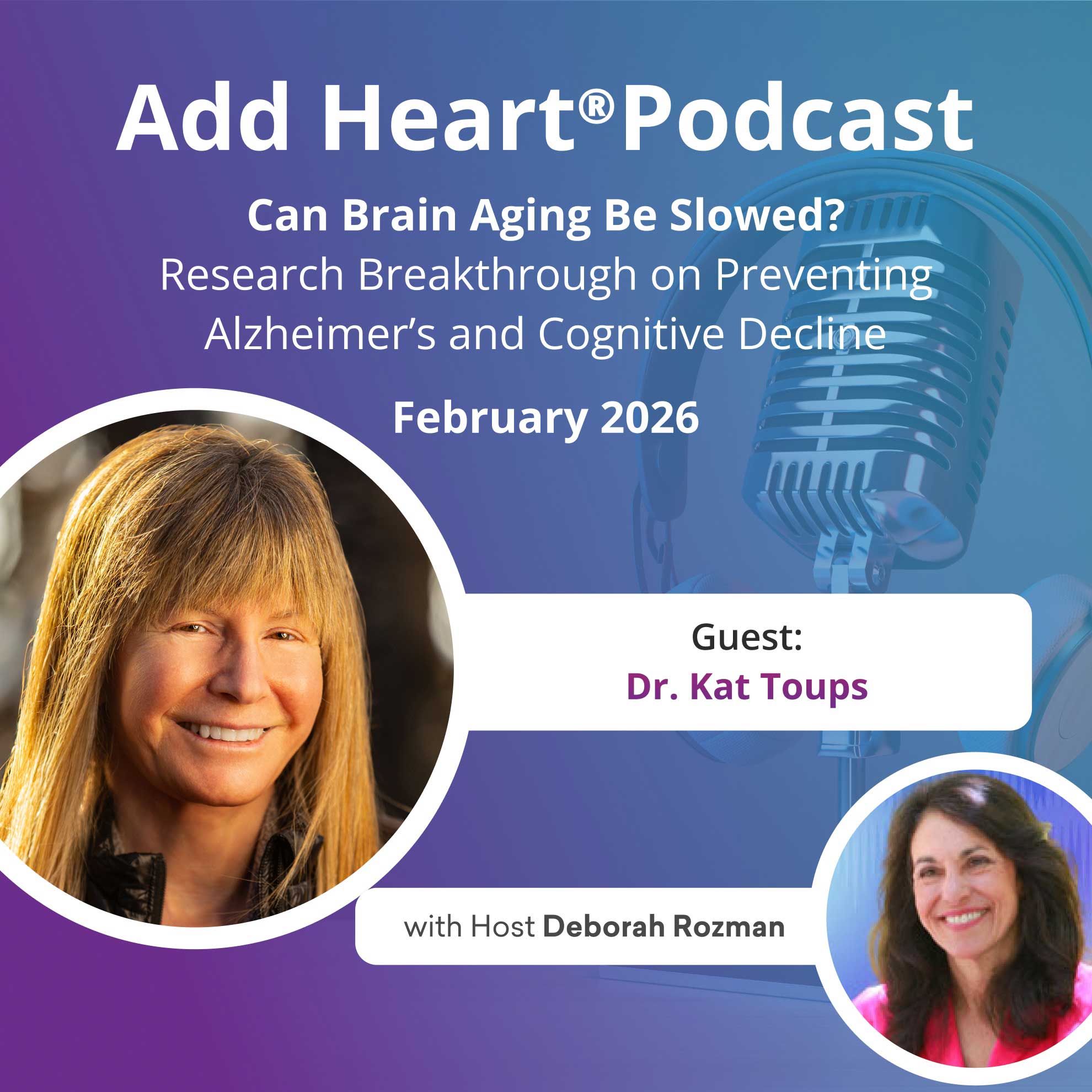
This month I'm talking with Dr. Cat Toups, a distinguished fellow of the American Psychiatric association, the highest honor bestowed by the APA.
And after serving as principal investigators on over 100 clinical trials for 12 years, including 20 failed trials for Alzheimer's drugs, she realized that the cure for brain and psychiatric illness was not going to be found in a pill and embarked on an intensive course of study, initially sparked by a quest to heal her own serious autoimmune disease, which we'll ask her about, to learn functional and nutritional medicine.
She's writing a book on resurrecting your brain and reversing cognitive decline.
And it's an approach she used in a clinical trial she conducted with leading anti aging longevity researcher Dr. Dale Bredesen, where 84% of the study patients with mild cognitive impairment and early dementia had improvement.
And more recently, Dr. Toops was the principal investigator in another soon to be published random controlled study that showed significant results for patients with early stage dementia due to Alzheimer's.
They saw significant improvements in memory, thinking speed and overall brain function. And to me, this is really hopeful and exciting for all of us. So welcome, Dr. Toops.
[00:02:52] Speaker A: Thank you. Thank you so much. I'm so happy to be here.
[00:02:56] Speaker B: Well, congratulations on your dedication and on this important research and the breakthrough results.
It's very important for people to know what's possible because there's so much fear, especially those of us who are baby boomers and getting older, that we're going to lose our cognitive faculties. But your study showed the magnitude of effects and the proportion of patients improved and the combinations of improvements that have never been seen before with any other treatment approach.
So tell us a little bit more about this most effective strategy reported today.
[00:03:38] Speaker A: Yeah, well, thank you so much for helping us to share the word, because as you mentioned, dementia just strikes fear into people's hearts.
You live long enough, almost one in two of us will get it if we live past 85. Of course, the very sad thing is that we're seeing dementia now at earlier and earlier ages.
When I was doing clinical trials, it was rare to see somebody in their 50s with dementia, but now it's not rare at all. So it is a, it is a global epidemic problem. But the good news is the, the work that we're doing, we're learning how to reverse it if, if we can get people before it's too, too far gone. And of course, everything that we learn about reversal also informs us about what to do for prevention. Right. That's of course, where the, the real money is. How can we prevent having the cognitive decline in the first place? But, yeah, so this new study that we did is as a replication of the earlier study that you mentioned that we had our proof of concept trial where 84% of patients got better. That was done at three sites with 25 patients. So smaller number. But our new study was done at six locations. We had 73 patients, subjects, and this is a randomized trial, so we had a comparison arm. They were randomized in a ratio of 2 to 1. So. So 2 out of 3 people got active treatment with the precision medicine approach that I'll say a little bit about. And then one third of the patients were basically, we call it standard of care neurology. So kind of whatever the neurologist would potentially do at this early phase, which is generally not much of anything.
The medications that are approved for Alzheimer's are not approved for mci. They're approved for early Alzheimer's and beyond.
An MCI is mild cognitive impairment, which is a stage that comes before you cross over into the threshold with Alzheimer's.
We had the comparison groups and I hope we'll never ever have to do a comparison group again and just use historical controls because the patients in the active treatment group got so much better in all domains of functioning that we looked at compared to the people that were getting standard of care, which we asked them not to change anything unless doctor ordered it.
We could watch them decline even in that nine month period.
The results, I think, are amazing.
It's an intensive program. What we do, it's precision medicine, functional medicine. What we do is we search out all of the different possible contributors for the decline in the brain.
Then we try to fix all of those things and so remove what's hurting the brain. A lot of times it's infections, it's toxins. It's, of course, the metabolic issues like the blood sugar regulation and the high lipids that are damaging the blood vessels that go to the brain.
It can be stress. I think we can talk some more about that. But so we work on the lack of hormones, all the different factors that help the brain. The nutrients, the B12, the vitamin D, the minerals.
So we fix all those things, and at the same time, we're working to help regain and regenerate the brain with neuroplasticity. So making new synaptic connections in the brain and that combination for us is where we see the great results. Remove all the causes and then do things to help regenerate the brain.
[00:07:31] Speaker B: Amazing. What role do you think stress plays in the development of early dementia or Alzheimer's disease?
[00:07:39] Speaker A: Yeah, I think both stress and depression are well known to cause neurodegeneration, the cascade of things that happens in the brain with those things.
So, you know, stress is a driver of all kinds of physical illnesses, and whatever's happening in your body also happens in your brain.
So all of those things are linked together.
Yes, I think stress is a big driver.
As you know, we had so much help from the heartmath team with both of our studies because we use the heartmath devices for a couple of reasons. In our study, patients, people that are sick, have to get into parasympathetic mode for healing.
When you're in the fight or flight, go, go, go that many of us are so much of the time, if we cannot shift into that calm parasympathetic state, things do not heal. If you can't sleep well, you need to get into deep sleep for brain restoration every night. So addressing the stress and being able to have people learn to shift themselves into that nice parasympathetic state is an important feature of what we do for both the healing and then also the regeneration of the brain. So neuroplasticity is the idea that our brain is plastic. It can make new connections. We know now, even up until the time of death, we're still making new connections in our brain. And that flies in the face of what I learned many years ago. When I was in medical school in the mid-80s, we were taught that you had all your neurons by age 18 and that was it. You were going downhill from there. But that is certainly not true.
Working with the.
We know that for regenerating your brain with the neuroplasticity, the best studied and best validated mechanisms to do that are exercise and meditation.
I love it that those. They're free.
They're free and accessible to everyone. You don't have to buy a device per se, though. Again, we love the HeartMath device because it informs people and teaches them more rapidly how to get into calm, parasympathetic state.
We've used it in both of our studies. And in this study, we had a lot of different tracking devices that were. Were available to us. So we were able to track how our patients were doing and their compliance.
And so it was an essential part of our program to help people to reduce stress and calm their mind and enhance their healing.
[00:10:34] Speaker B: You know, you said that by using the inner balance coherence feedback, the sensor for 10 minutes a day, which is what they had agreed to do, that was the minimum.
[00:10:45] Speaker A: Yeah.
[00:10:47] Speaker B: And that's interesting because that's about the heart and the heart rhythm. So the heart's important to brain health and I think that's really essential to understand that lowered their stress load to allow their brains to heal. And you said they learned to turn off the stress response that drives Alzheimer's pathology.
Tell us a little more what that means and how you measured it.
[00:11:14] Speaker A: Measured that. Well, we were also. I'll say we also used oura ring to track their sleep, which is also looking at their hrv. But the advantage of the heartmath inner balance sensor, of course, is that now it gives people feedback in real time of their HRVs, so they can use that to inform their state of relaxation, as you said, their heart focus. I think that's a beautiful part of the heart math program because I've experienced it many times myself. You know, you can start your relaxation and breathing and that will improve things. But definitely once you start focusing on someone or something that you love and release all those beautiful hormones that informs the hrv. So. Well, so we had people working with those things and we had our health coaches were trained heartmath help them with the training to be able to support our patients in the study. So in order to stay in our study, we had a lot of procedures people had to do and we had to assure that they were being compliant with all those procedures. We had a certain level of compliance. And if people weren't able to do that with the support we gave them, then we had to terminate them from the study because, of course, study won't work if you don't do what you're asked to do. So. So, yes, our health coaches help to support them, to get started and then to stay compliant.
[00:12:49] Speaker B: Wonderful. You said that.
I love this. You called HeartMath meditation for non meditators? Yes.
Many patients struggle just to try to sit and clear their minds. Not just patients, but any of us.
[00:13:02] Speaker A: Yeah.
[00:13:03] Speaker B: You know, half the meditation times people have is just trying to calm the mind. And of course, the power of the heart, that's what our research at HeartMath has found, helps to bring the mind into more quiescence when you activate heart focused breathing or the quick coherence technique. And the inner balance sensor, you said it gives patients something active to do, watching the feedback on the screen, training them into saying, oh, here's what gets me more in that coherent waveform.
And it makes it easier to stick with a habit like, easy for elderly patients to use at home, ensuring high compliance.
Say more about that experience.
[00:13:47] Speaker A: Yes. Well, you know, and I do love it because it's. It is such a simple, easy, elegant little device and it can be learned by children and it can be learned by older people with dementia. So, you know, that that is a definitely appealing thing, the meditation for non meditators. I came to realize this with a talk that HeartMath had many years ago when I was first learning about it by Dr. Wendy Warner. And he said, I'm an experienced meditator, I meditate regularly. And I was doing heart math, but I hit a stressful time. And she said her husband, I guess she'd been irritable and stressed, and her husband said, wendy, are you using your heart math? And she said, of course I am. But she said she wasn't. And she said he knew it and she knew it. So she said she went back to doing her heart math, and she had been meditating during that period. But she said the heart math really informed her meditation. And in doing the heart math, it helped her when she did meditate to be able to get into a deeper and, you know, perhaps more coherent, to use your terms, meditative state.
So what I like about it and love about it is just that it is accessible for people. You know, meditation doesn't work for everybody. It doesn't jive for everybody. And so this is something so easy and accessible and we can, you know, we can just see the results quickly and easily. So I think it's a useful modality and that's why we included it in our studies.
[00:15:27] Speaker B: You know, even myself as a 50 year dedicated meditator.
Sometimes life strain is such that you know you're not in your deepest place when you sit down to meditate. And if I just use the coherent sensor and feedback and go back to basics of heart focus, breathing and activating what I feel, genuine love and care for finding that rhythm, it sinks my heart and brain and I'm more cognitively clear and intuitive. So that's what a lot of the research studies from HeartMath are showing. But it's so fascinating to me that you're seeing this play into the reversal of dementia and that type of cognitive healing and you don't see these results with the leading pharmaceutical approaches, do you?
[00:16:19] Speaker A: Well, no, no, no. I mean our results are giant orders of magnitude better than what's out there with, with the medications. And I think most people are aware of really what a failure the medication protocols have been. They, they're not curing anything. They might give you a, you know, symptom relief for a very limited amount of time, but they're not curing things because again, we have to remove what's causing the degeneration and then also work on the rehabilitation of the brain.
[00:16:49] Speaker B: Right.
I understand that you suffered from early dementia, memory loss and recovered and that's a lot of your passion to look deeper, Tell us about your experience and how that motivated you to do this work.
[00:17:04] Speaker A: Yes, well, let me say that I worked with Alzheimer's and Alzheimer's research my entire medical career, which is getting longer than I want to say these days. But for. So I was already doing plenty of pharmaceutical Alzheimer trials when I was running the clinical trials Research center and they were failing. I mean, I worked with, you know, the first generation of drugs that was out there, you know, Aricep, Namenda, those kind of things, and they gave some symptom relief for people, but it didn't last for long. And even back then I worked with one of the anti amyloid drugs and we showed that that drug could wipe out the amyloid plaques in the brain, but it did not translate into clinical improvement, so did not get better.
But the pharmaceutical industry has continued over the last 20 years to do, you know, spend billions and billions of dollars on these medications for little tiny results with big bad side effects like brain bleeds in one in four people that can result in death. So I don't consider that an effective strategy. So backtrack. I was doing clinical trials and several with Alzheimer's and when I turned 50, I started having trouble with my cognitive function. And this was 16 years ago now. So I think people can tell that my brain is working pretty well now. But it was pretty scary back then. I think I was struggling so much I wasn't even afraid. I was just trying to survive. But I started to realize I was as cognitively impaired as some of the patients in my trials.
I would test them with many mental status exam where I had to give them three words to remember.
I had used those three words for more than 20 years, many, many times, right, Thousands of times. And I had two sets of three words that I alternated and I couldn't no longer remember those words. And so when I asked the patients to remember the three words, I would have to write them down to check their answer because I couldn't hold that in my head any longer. But things just got worse and worse.
I mean, as I realized I was struggling, I decided, okay, this is time, I need to close down my research center. And I, I moved my trials over to another center so they could continue. And I thought I would take a short time off of work and get better. But it was a three year journey and I, I, I started having trouble doing things on a computer. I could not remember how to do things I knew how to do. And I would ask my husband over and over, dorian, could you show me how to do this? And he'd say, I just showed you how to do that. And I couldn't remember, you know, that I had just asked him to do it.
I started having trouble sequencing things like driving my car. I could no longer back up my car or parallel park my car. Like my brain just couldn't sort those things out. I could try to parallel park over and over and over and finally give up and go find another parking place.
And I even developed auditory processing problems like I couldn't understand what was being said. And I kept going to the ENT and asking for hearing aids. And he would say, well, you just have a mild hearing loss. You don't need hearing aids. And then one day he, I went back in after a moment where I had been out to dinner at a quiet restaurant. And I could not understand anything that people were saying. I was just getting a little snatch of every word. And I said, I don't care, just I need some hearing aids. And he looked at me funny and he said, cat, this problem is not in your ear, it's in your brain.
And so I found out I had developed auditory processing problems where I could not decode properly what was being Said, and that's a problem that some we know and some children are born with that. But this was a new problem for me. I never had it before.
So it was a crazy time, things not working in my brain and getting worse and worse and having to stop working.
Fortunately, learned about and went to a conference called Food as Medicine. And, and I thought I ate healthy, but that opened my eyes to deeper levels of food as health. And they kept talking about functional medicine and the Institute for Functional Medicine. I said, oh, what is that? I, you know, sat back there and Googled it. And their next, their next module was autoimmune and allergy. So I signed up and went to that because I, in the process of all that was going on with my brain, I had developed multiple chemical sensitivity. I became allergic to everything, you know, food smells. I was covered with rashes, covered with hives.
So, like the work that we do with our patients now, something was going on with my body. And all that inflammation that was also inflaming my brain and causing, you know, all of the symptoms that I was having. So, so I started studying with functional medicine. And each module that I learned, I applied to myself. And working through all of those different layers and figuring out all of my own contributing factors were what I used to reverse it and get my brain to come back online.
[00:22:22] Speaker B: Amazing.
Well, you've poured your heart and soul into this research and with phenomenal results.
What do you hope might change as a result of this study becoming people, becoming aware of it? What, what impact do you hope is publication will have?
[00:22:39] Speaker A: Well, you just said the word twice that I want people to take away. Is that hope? I want people to understand that dementia is not a death sentence if you let it go. Just like, you know, if you have cancer and you don't treat it or do healing modalities, it's going to keep going. Well, same thing with dementia. So if you say there's nothing I can do and you let your brain keep degenerating, it will. But the exciting thing is it does not have to be a death sentence for, you know, I mean, I'm not going to say that we could help everybody. There's a lot of different reasons and kinds of dementia, but we're having great success with many different kinds of dementia. So that's the most important thing for me is for people to have hope and to realize that, that there are reasons this happens. You know, it is not some mysterious thing that just happens because of your genetics. Plenty of people get dementia that don't have The Alzheimer gene. And also I work with people that have two copies of the APOE4 Alzheimer's gene and they're doing preventative work for many years and they're doing fine. So genetics are just a small factor. And it's really the things that we do in our diet and our lifestyle and our illnesses that turn those genes on or off.
[00:23:51] Speaker B: I think that's so wise. Well, I know you're giving people and will give many more people great hope. We're going to close with a heart meditation, okay? Get our heart and brain in sync together for better cognitive function and health.
So let's do this together. Let's start with what we do with the inner balance that you use. Let's focus our attention in the area of the heart and do some heart focused breathing. Imagine your breath is flowing in and out of your heart or chest area, breathing a little slower and deeper than usual.
Just find an easy rhythm that's comfortable.
Now, keeping your attention continued in your heart focus, activate or recall a genuine feeling of appreciation, care, kindness or other heart quality for someone or something in your life.
This brings your heart rhythms into inner balance and harmony.
And as you do this, it activates heart brain synchronization, aligning your heart, brain and body.
Now radiate that heart quality or that heartfelt appreciation, care or kindness or compassion to all people suffering from dementia, Alzheimer's, trauma.
Radiate that heart hope to them.
Now let's close by co creating a reservoir of hard energy of compassionate care that each of us can tap into and draw on over the next month whenever we feel stressed or overwhelmed and need a lift in spirit or support and reconnecting with our heart, getting our heart brain back in sync. Let's have that heart energy and visualize that reservoir that we're co creating energetically.
Thank you so much everyone for sharing that heart meditation with me.
Dr. Tubes, what else would you recommend our listeners do in their daily lives to protect against early dementia and Alzheimer's? Anything you'd like to share?
[00:28:57] Speaker A: Oh, gosh. Well, you know, the foundational features for good health are, you know, diet, exercise, sleep and stress reduction. I mean, there's no magic there, but it is magic. If we, you know, take care and nurture all of those things, then that helps us with healthy aging.
I have to say that the exercise has turned out to be a big driver of healthy aging. The strength of the muscles turns out to be the best predictor of longevity these days.
Just go back to basics.
I think that's important.
[00:29:38] Speaker B: And you have A free ebook, Dementia Demystified that people can.
Yeah.
[00:29:44] Speaker A: Yes, I have a free ebook on my website. You can just go to my website. Dementia Demystified will get you there. Or you can just search Cat Tubes md It should come up pretty easily. And right at the top you can click and. I wrote this ebook a couple years ago. It's about 21 pages. And it kind of goes through all the things that we test and look at and the method.
It does not have the new brain biomarkers that we used in the study because those were, were not out at that time. But I, I just, I wrote that to have something to give people while I try to carve out the time to write a more definitive how to book for people. So yes, just go to my website if you're interested. I also have a YouTube channel that I. It's hard to keep up with, but I do have some talks on there. I did a full length talk at the Forum for Integrative Medicine annual meeting earlier in 2025 that goes through all of the factors that I look at when working with dementia. I hope that will be helpful for people.
I wanted to mention one more thing if I could.
I'm on the board of a new nonprofit organization called the Alzheimer's Survivors foundation. And their website is alzheimerssurvivors.org it was started by Dr. Dale Bredesen's Patient Zero, as he calls her, the first patient that, that he worked with to apply all of the same methods that I used in my own case, Judy Benjamin. And I think Judy has been recovered for about 13 years or more now. And she watched her parents die of dementia. And in celebration and to bring awareness to the fact that people recover and stay recovered, she started this organization and she walked across America at age 77.
She just completed that walk in December. She started in San Diego. She walked all the way to Florida.
She's my hero. She's just amazing.
If people are interested, they can just go to alzheimersurvivors.org and we're just trying to develop and share more stories of recovery and hope for people to know that Alzheimer's survivors exist.
They're real.
[00:32:10] Speaker B: It's incredible giving this much hope to people. I hope everywhere people get this because the fear of dementia, let alone the experience of it and the cascade into Alzheimer's is an epidemic.
And if we can help give people hope, that can be reversed with doing the things you're saying, managing the stress, getting your heart and brain connected, opening your heart, all the things that heartmath and you talk about and you know, as a free gift to our listeners, I want to give you all the online video learning course available on the HeartMath website. It's called the HeartMath Experience.
There's a HeartMath app you can download for free and play with it for seven days that has a coherent sensor built into it.
And yeah, just want to give people a lot of hope. That's our mission in life here.
So the third Tuesday of every month, we publish a new episode of the Ad Heart podcast. Be sure to subscribe so you don't miss our next guest and topic. And thank you so much, Dr. Toops. This has been very inspiring.
[00:33:24] Speaker A: Well, likewise, HeartMath has inspired me for many, many, many years. And I'm so appreciative of all the work and research that you guys are doing as well. But thank you for helping us to spread this, this message and to to highlight that there is hope.
[00:33:40] Speaker B: You're right. Thank you everyone. Take care.
[00:33:43] Speaker A: Thank you for listening to the Ad Heart Podcast. Be sure to subscribe so you can catch the latest episodes. If you're wanting even more heart inspired content, find us on Facebook, Instagram, YouTube and LinkedIn. Look for heart math and all. Also, the HeartMath Institute. Both organizations are committed to helping activate the heart of humanity.