Episode Transcript
[00:00:00] Speaker A: I thought I had it really cornered when I started, when I became a neuroscience coach and I was like, okay, this is great. I've got this cognitive ability down.
And then I realized I was missing an entire piece of the equation, which was your heart and how your heart actually was directing your brain and the quality of your thinking and the quality of your decisions and whether you're showing up today or in the past.
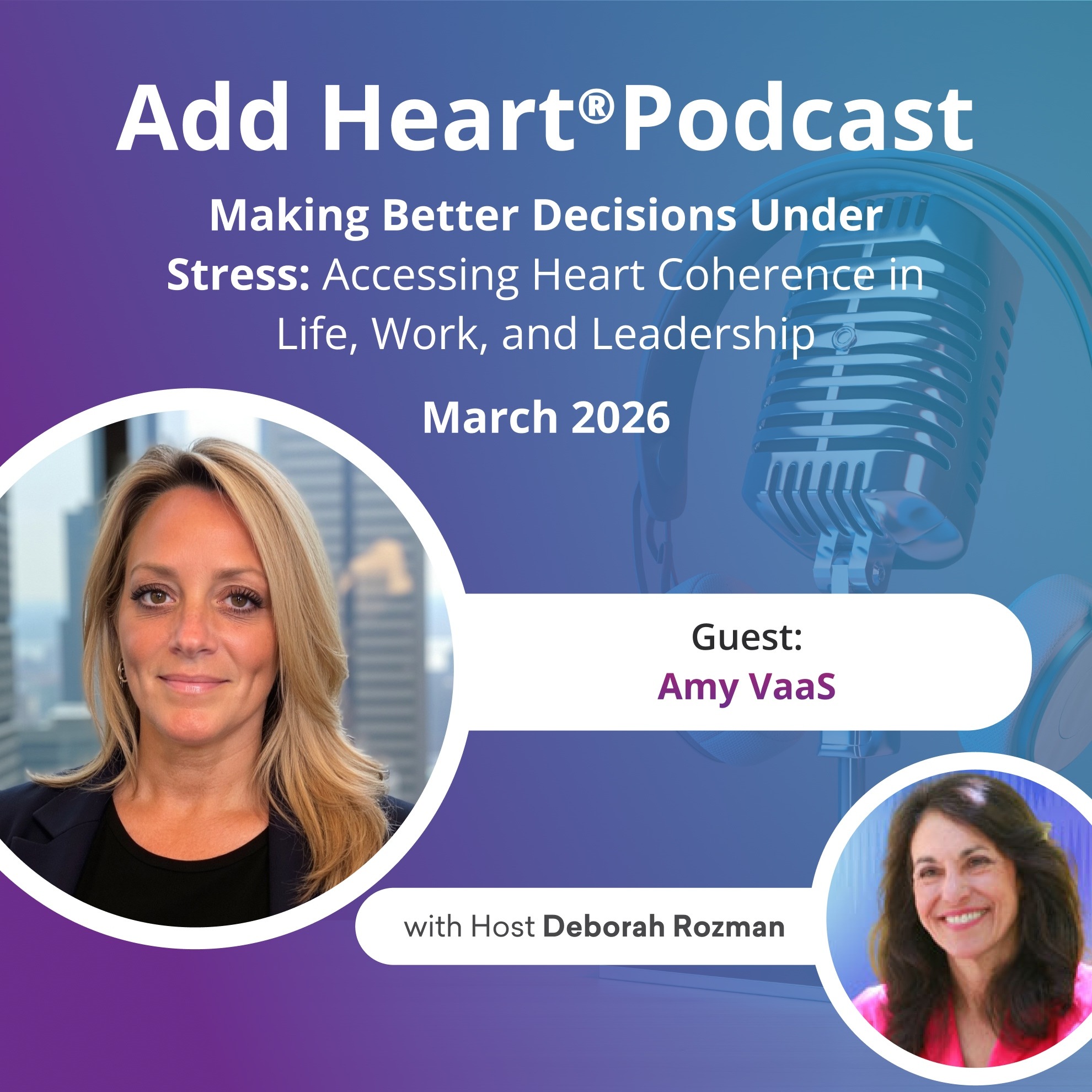
[00:00:29] Speaker B: Hi, I'm Deborah Rosman and a warm welcome to our listeners.
Each month for the At Heart podcast, I have the privilege of interviewing people who are contributing to the creation of a more heart based world.
This month I'm talking with Amy Voss, most recently the global well being leader at PricewaterhouseCooper, or PwC, a business consulting company currently ranked as number 20 on the Fortune list.
PwC operates in 149 countries with a global workforce of more than 370,000 people.
And as their global well being leader, Amy had the vision of bringing more heart into the business. And she successfully integrated Heart HeartMath practices first into their cybersecurity division, which has over 8,000 employees who care for the PwC organizations across the whole system.
And she also did leadership training programs internationally at the various locations where she integrated HeartMath tools.
So I was inspired to talk to Amy about what she did and found out she was heart inspired recently to launch her own business to bring the best practices she learned and how to overcome roadblocks to bringing heart intelligence to more companies.
So welcome, Amy.
[00:02:04] Speaker A: Hello. So nice to be here. Thank you, Debbie, for having me. It was quite an introduction.
[00:02:12] Speaker B: Well, it's great because you have been in the trenches doing this and you said, you know, the heart and business isn't soft as many people may think. It's strategic.
Can you say what you mean by this? Why is it strategic?
[00:02:27] Speaker A: I think it goes to a lot of different things, even to my own journey and understanding that the power of the heart and how one shows up is related to the two.
So I, one of the things that I share with people is that when I started on my journey, one of the things that I looked to improve upon myself was to understand how the brain worked. I was very, very curious really how humans think and why it's so hard for us to change. Myself in particular.
And I thought I had it really cornered when I started, when I became a neuroscience coach and I was like, okay, this is great, I've got this cognitive ability.
And then I realized I was missing an entire piece of the equation, which was your heart. And how your heart actually was directing your brain and the quality of your thinking and the quality of your decisions and whether you're showing up today or in the past.
And so I started to really recognize that being heart centered, having coherence was a strategic ability, a strategy in the way in which you can not just lead yourself, lead an organization.
And one of the things that I would also tell individuals when even teaching them this is it also gives you the ability when you're very present and when you're coming from a positive thinking space to not have to go back and apologize as much. So I consider that to be strategic too.
[00:04:19] Speaker B: I love that.
You know, especially today we all fumble. We can get cognitively overloaded, especially leaders and teams and it's increasingly difficult to even do forecasting or planning three years ahead or predict what's coming next.
So from your perspective, what happens to decision making and good judgment and collaboration when people are operating in that kind of overload and stress?
[00:04:53] Speaker A: It's such a great timely question and perspective to even be talking about. And there's no doubt today that leaders, teams that they're operating with competing priorities, urgent deadlines, they've got really packed schedules across workforces, there's even a lot of conversation around health and the importance of personal life. We've got devices that are distracting us, social media, we just have everything at an all time high.
I'm bringing that up really because the one thing I want to point out is that actually this overload isn't really new. You know, I started my career in corporate about 25 years ago. Hate twisted that on recording but even the, the environments then were really intense. The bar has been set high, long hours, many of the things that we see today.
But I think actually and to your question, what is feeling so different now is the level of uncertainty.
I mean we are right, we are operating in a world where AI, it's moving quickly, the markets are shifting extremely fast, information changes daily. I mean sometimes you go to bed and the next day you wake up and everything you knew about the day before, it looks totally different, right? And everybody's experiencing that.
So where I'm actually seeing this have an impact is that leaders are, they've always had to make difficult decisions. And actually there's a term called big bats. McKinsey's actually coined it a little bit and they describe it as unfamiliar high stake choices.
But today there was a time when you didn't have to make as many big bet unfamiliar high stake choices. And today, now it's because there's so much less predictability and there's less time to stop and think that this is actually becoming the way in which decisions are being made.
So the reality is that now we're making decisions that maybe you could say we have incomplete data around.
And it's becoming much more difficult then and in this uncertainty. Because the uncertainty is increasing the cognitive pressure and overload.
Right?
[00:07:24] Speaker B: Yeah, that's. Uncertainty is the big thing. I think that's underlying today's stress and why it's different for so many of us at home, at work, in life.
But given that reality in high pressure, analytical business environments, how did you introduce coherence in a way that resonated with skeptical professionals?
And what shifted in how teams operated under that level of performance pressure?
[00:08:01] Speaker A: You know, it's a great. This is a really, really great question too, because it's because of those environments is exactly why we introduced heart mass coherence practices wasn't even necessarily to fix a problem, but it was to strengthen the performance.
Because of the expectations that we have, we have high pressure, we're in analytical environments, precision matters, clarity under pressure matters.
And clients are expecting us to be steady.
Business leaders in particular had mentioned to me that they wanted their clients to feel like their experience was something different, something positive, that when working with us, we were the calm in the storm.
So it was a natural thing for me to think about how can we bring in something that brings people to this present state.
What was really interesting too is we chose to actually introduce it to these professionals that were working in highly technical areas like cybersecurity and risk.
Actually, they're paid to question assumptions in that environment.
Skepticism is not a barrier, it's a strength.
But knowing that if coherence was going to land, it actually had to stand up to their scrutiny.
So you must understand that explaining this too, and using words like heart and heart math and all these different things, we had to really think about being able to speak their language.
We didn't start with feelings, we started with the science of what's happening when the cognitively under pressure. And that really, really started to resonate.
What they really loved was that it was measurable. So using tools like the Inner Balance Trainer, people could see their coherence short coherence score shift in the real time. So it wasn't abstract.
Again, these are people that are looking for the skepticism so they could really feel the difference between reactive and a regulated state.
I would say that the shift happened not just because we explained the science, but also because of how they Experienced it.
I would say the other thing that we did really well with them was that we practiced it before they had the high stake moments.
So we didn't wait for them to be in an interactive state with clients or in their teens and stuff retreated it. The way you retreat building any skill is that you build it outside the moments that you're going to need it most so that it can become a part of how your everyday interactivity is. And actually that's how we would tell them about the inner balance trainer. We didn't have an expectation that they were going to walk around and necessarily have it clipped to their ear or that they, I know you've advanced the technology and you can look at it on your, you know, using fingerprints and those types of things.
But really what we explained to them was if you're using this and you can see your baseline shift, you'll also be, you'll, you'll be able to tell when your body is shifting in and out of coherence in the natural. When you're in those moments, that'll give you the pause. You can reset, you can re engage from that higher level thinking, wow, did
[00:11:39] Speaker B: you give them a protocol like use the inner balance sensor and get the feedback so many minutes a day or what worked?
[00:11:50] Speaker A: Yeah, so we tried many different ways about it actually and gathering feedback and things that we would start off with just saying two times a day, start your morning and your day. We recommended at least 5 minutes both those times a day.
And a lot of people, the feedback that we would get immediately, especially when people used it at night.
We had a lot of people who were coming to us, high stress, high anxiety, they were sleeping better and they were waking up better. Right.
So we got a lot of individuals who had that reaction.
We also got the other reaction where it was hard to find somebody to even relax for five minutes. So we would just ease them into it.
Give yourself a minute, try for a minute, do that, you know, form that little habit for a week, wait, try it now for two minutes, minute and a half, if you can't do two.
So we really, people get distracted so easily, you know, and we also. Debbie, the really interesting thing too was we had to move them away from thinking this was a meditative practice and that it was actually something that was shifting, you know, the parts of their brain that were going to allow them to have this reaction time that looked different than anything they had had before.
[00:13:24] Speaker B: And that's what they experienced. You know, based upon your experience with them, as you've described I can understand why you would position coherence maybe as a performance skill rather than just a wellness perk. What do you, you know, how did you put those two together?
[00:13:44] Speaker A: Yeah.
So when I describe coherence as well as more than a wellness initiative, I'm not dismissing wellness at all. Recovery, emotional regulation, human sustainability, they matter deeply. And actually sitting in my former role, as you mentioned, we actually introduce coherence under that umbrella, but in practice, because we knew it operated as something different, that it strengthened people's capacity to perform under pressure and across the whole system, the whole organization.
This is really where we could be able to explain it to them, that it's more than just feeling well, it's performing at your best.
You know, it's not a coherent being in a coherent state isn't actually a nice to have. It's foundational to how you think, to how you relate and how you deliver, how you team together. So how you're showing up and all that really mattered in your performance, in every interaction that you had.
So it wasn't a nice to have.
[00:15:01] Speaker B: Right.
Did you get any feedback from the leaders that you were training that the inner balance coherence practice improved their decision making or changed how they made decisions?
[00:15:17] Speaker A: Absolutely. In fact, because we also would do. Our programs included a lot of different things. One of the things too was coaching directly and in particular with leaders.
So I would say a couple things would happen.
So first, what we were finding is that the leaders that we were coaching were using this tool before they even got on, like a client conversation or something of that nature.
And so it allowed them, when they would have a meeting, when they were talking, that they were already in that. That high functioning state that they were listening, they actually found their listening skills better.
They were able to communicate things differently. And really they were in that, you know, really was a calmer state that they didn't find themselves reacting when they had to make a decision. Or it made them comfortable to even be saying things like, let me get back to you on that without nervousness around that. So they found that in their personal experiences. But what we actually witnessed, this was actually one of the things that was really cool that we witnessed is so one of the things we would do is start their meetings off doing sort of either we would do quick coherence or we would do just hard, focused breathing, whatever we needed, whatever called for, for the day.
So we would. He would bring his. This, this particular leader would bring his teams together and he found that his meetings were shorter.
[00:16:52] Speaker B: Mm.
[00:16:53] Speaker A: I've Heard that everybody was. Yeah. So his meetings were shorter.
Um, we also found one of the greatest things was so not everybody had to show up every day. These were daily, like quick 15 minute touchpoint calls.
But he found that all his team members showed up for the first few minutes to just get in coherence for their day, even if they didn't stay for the rest of the meeting.
[00:17:18] Speaker B: Yeah, I love that.
So given all that wonderful experience you've had, that practical experience and learning, how have these lessons you've learned from being able to embed coherence in a complex organization shaped how you are now approaching your new role of leadership advisor and high performance under stress? What are you doing now?
[00:17:50] Speaker A: So I'm really taking all the things that I've learned and offering it through VaaS solutions as Matt that I introduced coherence, even as a standalone intervention, I'm really integrating it directly into the leadership advisory work. For example, when I'm working with senior leaders on strategy, decision making, or navigating change, we're not just talking about the priorities and the structure. We're also looking at their internal state and how they're influencing these moments, how quickly they escalate things, how quickly they can recover, and the tone that they're actually setting in the room.
Because the strategy, which is a lot of times that I'm working with people on, doesn't actually execute itself. It's in the people.
Right. And so how they're showing up really matters on how well the things that they want to do and accomplish get done.
So that's one of the examples, you know, we've got. When I'm doing team effectiveness work, coherence really becomes a way to help the teams recognize that reactivity can drive that miscommunication. I know you all have amazing statistics around the level of miscommunication that's even happening.
This is a great way for them to really learn coherent communications and to build those simple, repeatable reset practices so that they can actually be heard, understood, what's not being said. And so it's really impactful with the teams, but then again, how they're showing up in the rest of the world.
And the piece that I really, really love and I'm so focused on, one of my missions has been to really think about the organizational and culture level at a firm.
And, and so where I see this is, is that when you recognize how this is showing up within individuals and how the coherence can, you know, it's a stabilizing mechanism inside the leadership challenges and it's not separate for them. And it really can have a massive impact on their overall culture. And what leaders and cultures care about is not just their people, but also performance, profitability, sustainability, being innovative, being relevant. All these things are sitting on their mind. Competing with not just care that they may have, it's also just how successful we're going to be. I see this as a real fundamental shift in change in how the entire organization operates.
[00:20:43] Speaker B: That's exciting. If we can really get this coherence implemented everywhere.
I appreciate what you're doing on that. And the receptivity is increasing.
One of the things I wanted to ask you about, you know, as a CEO of a company, I read different CEO magazines and they talk about how intuition is what people have to. After they get all the data, they have to just use their intuition on what choices, decisions to make.
And we're researching team synchronization. You know, when hearts really synchronize in coherence, people get into coherence on the inner balance and they do it as a team.
Then what happens is a shift in team dynamics where there is more actually collective heart, brain synchronization as well. For more intuitional cutthroughs on issues.
Did you address intuition at all or did you find that in your work?
[00:21:49] Speaker A: So the way that we would approach things of that nature were we would use some of the examples. We had to be. You have to, it's no joke when I say we've got to really be able to use the words that resonate with the audience that's in front of you.
[00:22:08] Speaker B: I hear you. So.
[00:22:10] Speaker A: Right. So intuition can be one of those things when you have a skeptical audience. And so, so. But I'll tell you how we would use that.
[00:22:19] Speaker B: Right?
[00:22:19] Speaker A: Because relational intuition and those kinds of things we actually used and we would reference and then we would have them practice it. Where you have the study where you did the four people and you had three of them go in and out of coherence and it shifted the other person. So this was massive with the teams where we were able to be. Because we were able to practice it, we were able to show it.
And one of the main reasons that we had really thought about that was because if you're going out and you have client facing individuals, if your team can go in not just with the strategy, the mission at hand, the task they have to get done, but with an emotional state that can carry the room, you can then shift the client to be meeting you where you are rather than you where they are.
And so that is really how we introduce this thing of like intuition because I always think of it as when your heart connected, that is your intuition, you know, that that's me personally and I, you know, and it's interesting too, but generationally I'm finding there are different words that are resonating and you can talk a little more open. Right. As depending on. Depending on what maybe somebody is on their life cycle of work.
Right.
[00:23:47] Speaker B: What a wonderful answer. I really appreciate that.
Well, everybody has a business, they're involved. And whether it's our running a household or the business of our own health or the company that we work with or whatever. So let's close together with a heart meditation on bringing more heart and coherence into whatever business we're involved in.
And I so appreciate everything you've said, Amy. It's just very inspiring. So let's focus our attention in the area of the heart and just imagine your breath is flowing in and out of your heart or chest area, breathing a little slower and deeper than usual.
Find an easy rhythm that's comfortable.
As you continue heart focus breathing, activate or recall a genuine feeling of appreciation, care, kindness, love or other heart quality you have for someone or something in your life.
This brings your heart rhythms into inner balance and harmony. It activates heart coherence and aligns your heart, brain and body.
Now in this state of heart brain synchronization, stay focused in your heart and ask where you could bring more heart into your business and how that would be strategic for you.
What we call at heart math business, heart.
[00:26:38] Speaker A: It.
[00:27:14] Speaker B: And now, whatever inspiration you got from that or suggestions or prompting, make a commitment to follow through, step into it, see what happens.
Let's close now by co creating a reservoir of coherent heart energy that each of us can tap into over the next month. Whenever we feel overloaded, stressed or just need a lift in spirit or support in connecting with our heart, just visualize this reservoir of collective heart energy that we're building.
Okay, thank you so much for doing that heart focus meditation with us, Amy. Is there anything else you'd like to share with our listeners?
[00:28:41] Speaker A: No, just really thank you so much for having me on, for bringing awareness to this in the business space.
I really do feel think heart is our future for business.
So I'm excited to be on this journey with you and you know, just anyone else who can consider how they can use it or implement it, I recommend take a deep look at it. It's quite an incredible shift.
[00:29:08] Speaker B: Well, thank you so very much.
And as a free gift to all of our listeners.
You can watch the HeartMath experience. It's an online video learning course available on the HeartMath websites that will help you use the coherence tools and understand the science behind it.
And you can download the HeartMath app from the App Store. Google Play stores that has a built in heart coherence sensor. So it'll give you an idea of how as you do these coherence techniques, your heart rhythms change and increase coherence.
And of course you can get the inner balance sensor that Amy talked about. It gives you lifetime access to the new HeartMath app.
So let's create some coherence together in this world. And I want to remind you that the third Tuesday of every month we publish a new ad Heart Podcast episode. So be sure you subscribe so you don't miss our next guest and topic.
Thank you for listening and take care.
[00:30:17] Speaker C: Thank you for listening to the Add Heart Podcast. Be sure to subscribe so you can catch the latest episodes. If you're wanting even more heart inspired content, find us on Facebook, Instagram, YouTube and LinkedIn.
Look for HeartMath and also the HeartMath Institute. Both organizations are committed to helping activate the heart of humanity.